
Custom WordPress Development vs Templates in 2026: Which Is Better for SEO?

Custom WordPress development vs. templates is a decision most businesses approach with a budget in mind rather than a strategy. They see a $59 theme that looks professional and wonder whether investing 10 or 20 times that amount in a custom build is genuinely worth it or just an agency upsell.
In 2026, the custom WordPress development vs templates debate is no longer just about cost, it is about visibility. The choice between a template and a custom build is not primarily a financial one; it is a visibility one. With search engine infrastructure now heavily weighted toward technical performance and crawl efficiency, the architecture you choose affects whether your target audience can actually find your content.
This article examines the structural differences between these two paths, identifying where each makes sense and clarifying the mistakes most brands make when trying to scale.
Custom WordPress Development vs Templates: The Reality of Technical Authority
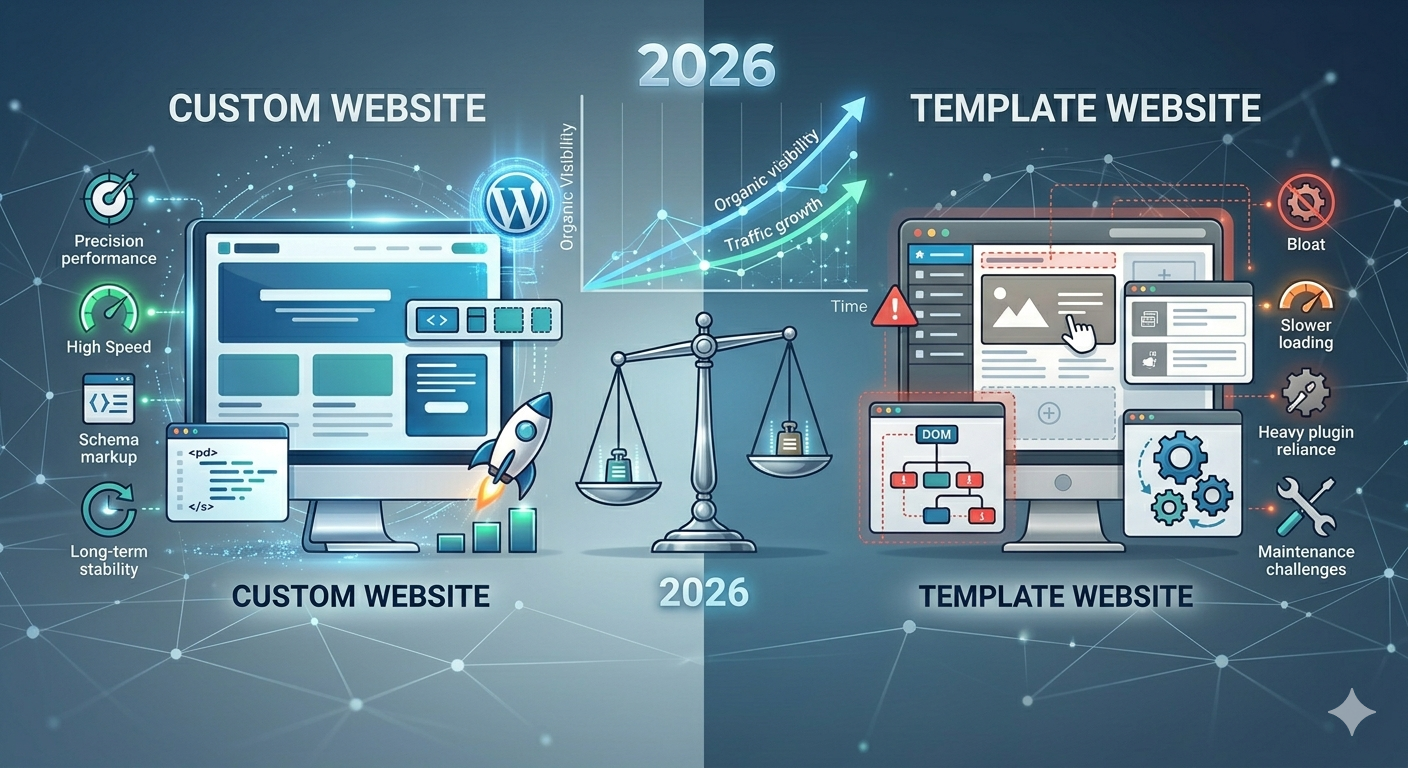
When comparing custom WordPress development vs. templates, the gap becomes most apparent in how search engines “perceive” your site. Most premium templates are designed to be multipurpose. To achieve this, they ship with massive amounts of redundant code, including legacy scripts and multiple layout engines that your specific site will likely never use.
This leads to what developers call DOM bloat. It is a complex document structure that forces search crawlers to work harder to find your actual content. Google allocates a finite crawl budget to every website, and as detailed in Google’s documentation on managing crawl budget, unnecessary page complexity can lead to slower indexing of your most important pages.
On a custom build, every line of code exists for a reason. This clean environment allows search engines to move through your content with total efficiency. It also allows for the precise implementation of Schema markup as per Google’s structured data guidelines, which is essential for securing rich results and AI-driven citations in 2026.
Performance as a Ranking Factor
Core Web Vitals have moved from being a technical suggestion to a critical tiebreaker in competitive search landscapes. The reason custom sites consistently outperform templates in this area is foundational. Popular page builders often inject multiple “wrapper” layers around every element on a page, which increases the time to first byte and delays the largest contentful paint.
A site that loads in four seconds instead of one does not just frustrate users; it signals to modern algorithms that the page is a lower-quality result. While optimization plugins can help a template-based site, they are often just masking underlying structural issues. True speed in 2026 comes from a lean, block-based architecture that prioritizes the user’s mobile experience from the first byte.
The Cost and ROI Calculation
The upfront cost of a template is undeniably lower, usually involving a few thousand dollars for setup and design tweaks. However, the long-term maintenance can be high. Template sites rely heavily on third-party plugins to handle basic functions. As those plugins update, conflicts arise, creating a cycle of “fix-it” development costs.
Custom builds require a larger initial investment, often starting in the mid-five figures. The return on that investment is found in stability and longevity. Because the site is built on a bespoke foundation, it is not subject to the whims of a theme developer or the instability of a dozen competing plugins. You are paying for a strategic asset that can remain performant for five to seven years, rather than a theme you will likely need to replace in two.
Strategic Thinking and Approach
One of the most common pitfalls we see is the attempt to “force” a template into becoming a custom site. When a business buys a theme and then spends hundreds of hours trying to change its core logic, they end up with a high-cost site that still carries all the technical debt of a template.
At Lucanix, the methodology for choosing an architecture always begins with a deep dive into search intent and competitive data. We find that the decision should never be based on personal preference but on what the data reveals about the target market. Competing with a bloated template becomes an uphill battle when technically superior custom sites dominate a business’s primary keywords.
By analyzing keyword research and the technical health of competitors first, Lucanix helps brands identify the exact point where a custom build becomes a financial necessity for growth. This data-driven perspective ensures that the website architecture supports the SEO strategy rather than hindering it.
Use Case Scenarios for 2026
In the custom WordPress development vs. templates context, for a startup or local service provider in the early stages, a lightweight, well-coded template is often the smartest move. At this stage, speed to market and content testing are more important than perfect technical architecture. The priority should be establishing a presence and refining the offer.
For scaling brands and SEO-focused organizations, the technical precision of a custom build is a requirement. If organic search is the primary way you acquire customers, you cannot afford to have your growth capped by the structural limitations of a generic theme. In a world where AI models are increasingly used to synthesize web information, being the most “parseable” and authoritative source in your niche is a significant competitive advantage.
Final Verdict
The debate around custom WordPress development vs templates is no longer just about cost. If your business goals for 2026 include dominating high-competition search terms, custom WordPress development is the superior choice. It provides the speed, security, and flexibility required to stay ahead of algorithm shifts. However, if you are working with a limited budget and need to launch quickly, a template is a viable starting point, provided you choose a lean option and keep your plugin count to an absolute minimum.
FAQ
Is a custom site harder for a marketing team to manage?
No. Modern custom builds utilize the native WordPress block editor, which is just as intuitive as a visual builder but far more efficient.
Can I switch from a template to custom later?
Yes, but it often requires a full redesign and a careful SEO migration to ensure you don’t lose the rankings you’ve built on the old structure.
Does Google prioritize custom sites over templates?
Not directly. Google prioritizes the results of the code, speed, structure, and user experience. Custom sites simply make it much easier to hit those high standards consistently.
How long does a custom build typically take?
Most professional custom projects require eight to twelve weeks, which includes a heavy focus on strategy, design, and performance testing before launch.