
B2B Website Best Practices: How to Turn Your Site Into a Lead Generation Machine
Apply these b2b website best practices to turn your site into a lead engine. Page structure, trust signals, CTAs and lead capture, without paid ads.

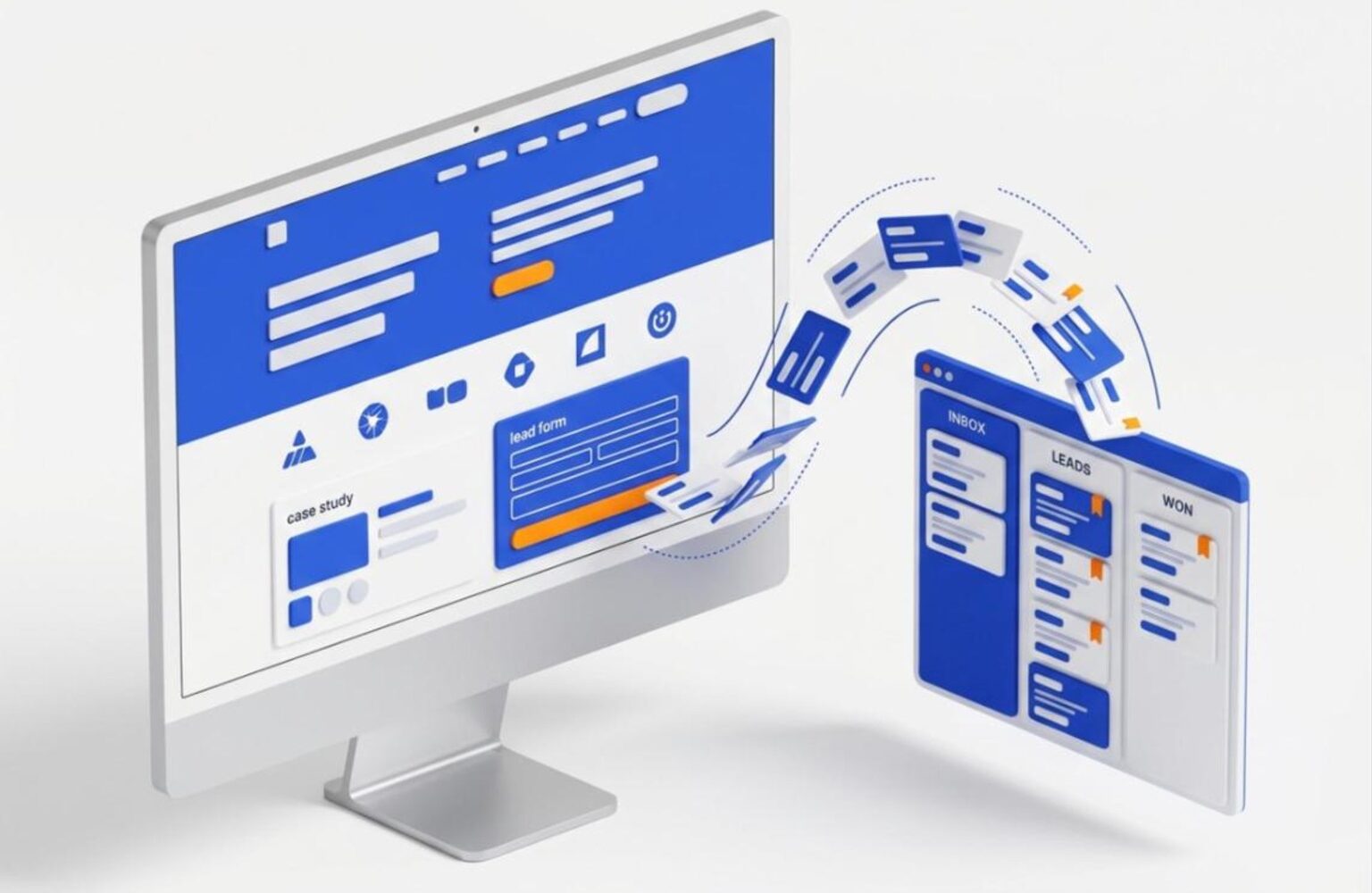
The most important b2b website best practices come down to one idea: your site is a sales asset, not a brochure. Most B2B websites fail because they describe the company instead of helping a buyer make a decision. The result is traffic that never converts and a sales team that blames marketing for weak leads.
This guide covers the page structure, trust signals, calls to action, and lead capture tactics that turn a B2B site into a reliable pipeline source. None of it requires paid ads. All of it can be implemented by a competent team in 6 to 10 weeks. We build and rebuild B2B sites for SMBs and startups across the US, Canada, and the UK, so the advice below comes from what moves numbers, not what looks good in a design review.
Why Most B2B Websites Fail to Generate Leads
A typical B2B website converts 1% to 3% of its visitors into leads. That is the median, and plenty of sites sit below 1%. The gap between a 1% site and a 4% site is rarely design polish. It is clarity, proof, and friction.
The common failure patterns are consistent. The homepage leads with a vague mission statement. Services are described in internal jargon. The only call to action is a generic “Contact Us” link in the navigation. Case studies are buried or missing. Forms ask for 12 fields before anyone has seen a price range or a process.
B2B buying also works differently from consumer buying. Decisions involve multiple stakeholders, longer research cycles, and real risk. Your website has to serve a researcher on Tuesday, a finance approver the following week, and a technical reviewer after that. Each needs different information, and each will leave quietly if they cannot find it.
Treat every page as having one job. If you cannot state what action a page should drive in a single sentence, the page is not ready. That discipline is the foundation of every b2b website best practice that follows.
Start With a Clear Value Proposition Above the Fold
Visitors decide within roughly 5 seconds whether a site is relevant. Your first screen has to answer three questions: what do you do, who is it for, and what happens next. Anything that does not answer one of those three is decoration.
A weak headline: “Innovative solutions for modern businesses.” A strong headline: “Fixed-price WordPress and Next.js builds for B2B companies that need qualified leads.” The second one filters out the wrong visitors and pulls in the right ones. That is a feature, not a bug.
Build the hero section with four elements:
- A specific headline naming the outcome and the audience.
- A supporting line of one or two sentences explaining how you deliver it.
- One primary CTA with action-oriented copy, such as “Book a free consultation”.
- One proof element, such as a client logo row or a headline result.
Resist the urge to add a carousel. Rotating banners dilute the message and hide most of your content from people who never click through. One clear message beats four mediocre ones.
Test your hero with someone outside your industry. Show it for five seconds, then ask what you sell and who it is for. If they cannot answer, rewrite it before touching anything else.
B2B Website Best Practices for Page Structure and Navigation
Good B2B website best practices for structure start with a short, logical navigation. Five to seven top-level items is the working limit. Anything more forces visitors to think, and thinking is where they leave.
A proven B2B site architecture looks like this:
- Home: positions the offer and routes visitors to the right next step.
- Services or Solutions: one page per core service, each targeting its own search intent.
- Case Studies: proof organized by industry or problem.
- About: the team, the process, and why you exist.
- Resources or Blog: content that earns organic traffic and answers buyer questions.
- Contact: a low-friction conversion page.
Give each service its own page rather than listing everything on one. A single “Services” page cannot rank for five different search intents, and it cannot speak to five different buyer problems. Dedicated pages do both. If you are weighing platforms for that structure, our comparison of Next.js vs WordPress in 2026 explains how each handles scalable page architecture.
Keep the primary CTA visible in the header on every page. A sticky “Book a consultation” button costs nothing and catches visitors at the exact moment of intent, wherever they are on the site.
Build Trust Signals That Reduce Buyer Risk
B2B buyers are protecting their budget and their reputation. A bad vendor choice can cost a procurement lead their credibility. Trust signals exist to lower that perceived risk, and they work best when placed near decision points, not saved for an “About” page.
The trust signals that carry the most weight, in rough order of impact:
- Named case studies with numbers. “Increased qualified leads by 142% in 5 months” beats “great results” every time.
- Client logos from recognizable or relevant companies, placed in the hero or directly beneath it.
- Testimonials with a name, title, company, and photo. Anonymous quotes are ignored.
- Third-party validation such as Clutch or G2 reviews, certifications, and partner badges.
- Visible team members. Real faces and bios make a vendor feel accountable.
Be honest about specifics. If you cannot share a client name under NDA, share the industry, company size, and the measurable outcome. Vague proof reads as no proof.
Security and compliance also count as trust signals. A visible privacy policy, HTTPS, and accessible design tell enterprise buyers you take risk seriously. See our guide on web accessibility standards for why compliance is now a procurement filter, not just a legal checkbox.
[CTA_PLACEHOLDER_REMOVED]
Write Calls to Action That Match Buyer Intent
One of the most overlooked b2b website best practices is matching the CTA to where the buyer is in their journey. A first-time visitor reading a blog post is not ready to “Request a Demo.” Asking too early kills the click and wastes the visit.
Think in three intent tiers:
| Buyer Stage | Typical Page | Best CTA |
|---|---|---|
| Awareness | Blog, guides | Download a checklist, subscribe, read a related guide |
| Consideration | Service pages, case studies | See pricing ranges, view a case study, take an assessment |
| Decision | Pricing, contact, proposal pages | Book a free consultation, request a fixed-price proposal |
CTA copy matters more than button color. “Get started” is vague. “Book a free 30-minute strategy call” tells the buyer exactly what they get and how long it takes. Specificity removes uncertainty, and uncertainty is the main reason people hesitate to click.
Place CTAs after every proof point. A case study result is the moment of highest persuasion; a CTA directly beneath it captures that momentum. Aim for one CTA per screen of scrolling, never more than two competing options at once.
Offer a lower-commitment alternative beside your main CTA. Not everyone will book a call on the first visit. A secondary option such as “Download the pricing guide” keeps those visitors in your pipeline instead of losing them entirely.
Design Lead Capture Forms That People Actually Complete
Every extra form field reduces completion. Research from multiple form analytics studies shows that cutting a form from 11 fields to 4 can lift conversions by roughly 120%. For a B2B lead generation website, this is the fastest win available.
Start with the minimum you need to follow up: name, work email, and one qualifying question such as company size or project type. Collect everything else on the sales call, where you can ask in context and build rapport at the same time.
Follow these form rules:
- Use single-column layouts. They complete faster than multi-column grids.
- Label fields clearly and avoid placeholder-only labels that disappear on focus.
- Show a response promise such as “We reply within one business day.”
- Explain what happens next in one line beneath the button.
- Make errors obvious and keep entered data when validation fails.
Consider a short qualifying step for higher-ticket services. A two-step form, where step one asks a single easy question and step two collects contact details, often outperforms a single long form because early commitment builds momentum.
Finally, test the form on mobile. Over half of B2B research now begins on a phone, even if the final inquiry happens on a desktop. A form that is painful to tap through loses leads you will never see in your analytics.
Use Content to Capture Leads Without Paid Ads
Paid ads rent attention. Content earns it permanently. A B2B website that ranks for the questions buyers ask pulls in qualified traffic every month at a declining marginal cost. That is how you generate leads without paid ads.
Build content around three buyer needs: problems they are trying to solve, comparisons they are weighing, and costs they want to understand. Pricing-intent content is especially strong. A buyer searching “how much does a B2B website cost” is far closer to purchase than one reading a trends article.
Pair every high-traffic post with a relevant lead magnet. A post on website redesigns pairs naturally with a downloadable checklist. Our website redesign checklist is built on exactly that model. The reader gets immediate value, and you get a warm contact who has self-identified a problem you solve.
Structure articles so they can be cited by AI search engines too. Use clear H2 headings phrased as questions, concise definitions near the top, and specific numbers. This is the core of generative engine optimisation, and it increasingly decides who gets recommended when buyers ask ChatGPT or Perplexity for vendors.
Consistency beats volume. Two well-researched posts per month, each tied to a conversion path, outperform ten thin posts with no next step. A documented plan helps here; our content strategy framework lays out how to build one.
Make Technical SEO and Speed Part of Your Conversion Strategy
Speed is a conversion factor, not just a ranking factor. Google’s own data shows that as page load time goes from 1 second to 3 seconds, the probability of a visitor bouncing increases by 32%. B2B buyers are no more patient than consumers, especially on mobile.
Target a Largest Contentful Paint under 2.5 seconds, as defined in Google’s Core Web Vitals guidance. The usual culprits are oversized images, render-blocking scripts, and bloated page builders. If your site runs on WordPress, our WordPress speed optimization guide covers 12 fixes that cut load times.
Technical foundations also determine whether your content gets found at all. Make sure every service page has a unique title tag, a descriptive meta description, clean URLs, and schema markup for your organization and services. Run a regular crawl to catch broken links, duplicate pages, and indexing errors. Our technical SEO audit checklist lists 20 issues worth checking.
Finally, install proper tracking before you launch changes. Set up conversion events for form submissions, calendar bookings, and key button clicks in Google Analytics 4. Without that data, you are optimizing blind and cannot tell which changes actually produced leads.
Optimize Your B2B Website Conversion Rate With Testing
Improving your b2b website conversion rate is an ongoing process, not a launch task. The teams that win treat the site as a product, with a backlog of hypotheses and a regular testing cadence.
Start with qualitative research before running A/B tests. Install a session recording and heatmap tool and watch 30 to 50 real sessions. You will quickly see where visitors hesitate, rage-click, or abandon. Pair that with 5 customer interviews asking why they chose you and what almost stopped them.
Then prioritize tests by expected impact and effort. High-impact, low-effort tests usually include:
- Rewriting the homepage headline to name the audience and outcome.
- Moving a case study result above the fold.
- Shortening the contact form by removing two fields.
- Changing generic CTA copy to specific, outcome-based copy.
Be realistic about sample size. A site with 2,000 monthly visitors cannot run a statistically valid test on a 1% conversion difference in a week. For lower-traffic B2B sites, make larger changes, run tests for 4 to 6 weeks, and rely on qualitative signals alongside the numbers.
Document every change and its result. After six months you will have a clear picture of what your specific buyers respond to, which is worth more than any generic best practice list, including this one.
How to Measure Whether Your Website Is Generating Real Pipeline
Leads are not the goal. Revenue is. A site that produces 100 unqualified form fills is worse than one that produces 15 sales-ready conversations. Measurement has to connect website activity to pipeline and closed deals.
Track these metrics, in this order of importance:
- Qualified leads per month, not raw form submissions.
- Lead-to-opportunity rate, showing how many leads sales actually pursue.
- Cost per lead by source, including the real cost of content and SEO.
- Pipeline and revenue attributed to organic search.
- Visitor-to-lead conversion rate by page and traffic source.
Connect your CRM to your analytics so each lead carries its original source and landing page. Without that link, you cannot tell whether your blog, your service pages, or your referral traffic is driving revenue. Our framework for measuring SEO ROI walks through the attribution setup step by step.
Review the numbers monthly with both marketing and sales in the room. When sales says leads are weak, look at the form questions, the CTA promises, and the pages those leads came from. Most quality problems trace back to a mismatch between what the site promised and what the company actually delivers.
A 30-60-90 Day B2B Website Improvement Plan
You do not need a full rebuild to apply these b2b website best practices. A phased plan lets you capture early wins while building toward larger structural changes.
Days 1 to 30: Fix the fundamentals. Rewrite the homepage hero, add a sticky header CTA, shorten your main form, and publish or surface your three strongest case studies. Install analytics events and session recording. These changes are fast and often produce visible lift within weeks.
Days 31 to 60: Strengthen structure and proof. Build dedicated pages for each core service, add testimonials with full attribution, and create one lead magnet tied to your highest-traffic page. Run a technical SEO audit and fix speed issues flagged by Core Web Vitals.
Days 61 to 90: Build the engine. Launch a content calendar focused on pricing, comparison, and problem-solving topics. Begin A/B testing headlines and CTAs. Connect your CRM so you can see which pages produce pipeline, not just form fills.
If your current site has deeper structural problems, a rebuild may be the faster path. Our redesign checklist helps you decide, and a clear brief keeps costs down. Fixed-price B2B builds typically run $1,500 to $10,000 depending on scope, with content and SEO retainers from $800 to $2,000 per month.
Common B2B Website Mistakes to Avoid
Even teams that know the right b2b website best practices fall into predictable traps. Avoiding these saves months of wasted effort.
- Designing for the company, not the buyer. Internal opinions about the logo and tagline do not predict conversion. Buyer research does.
- Hiding pricing entirely. You do not need exact prices, but ranges filter bad-fit leads and build trust. Silence on cost makes buyers assume the worst.
- Gating everything. Locking every resource behind a form kills traffic and links. Gate only your highest-value assets.
- Ignoring mobile. A desktop-only review process misses the experience of a large share of visitors.
- Launching without measurement. If you cannot attribute leads, you cannot improve them.
- Treating the site as finished. Sites decay. Content ages, plugins break, and competitors improve. Ongoing maintenance is part of the plan.
The pattern behind all of these is the same: decisions made on assumption instead of evidence. The fix is also the same. Talk to buyers, watch real behavior, test changes, and let results guide the next move.
A B2B website that generates leads is built on clarity, proof, and low friction, then refined with data. Start with the hero, fix the form, surface your proof, and measure what happens. That sequence alone moves most sites meaningfully forward.
Frequently Asked Questions
What are the most important b2b website best practices?
The essentials are a clear value proposition above the fold, a simple page structure with one page per service, visible trust signals such as named case studies, intent-matched CTAs, short lead forms, and fast load times. Add conversion tracking so you can measure and improve results over time.
What is a good B2B website conversion rate?
Most B2B sites convert between 1% and 3% of visitors into leads. Well-optimized sites with strong offers and clear proof often reach 4% to 6%. Your rate varies by traffic source, deal size, and offer, so benchmark against your own baseline first.
How can a B2B website generate leads without paid ads?
Rank for buyer-intent searches with service pages and helpful content, pair popular posts with relevant lead magnets, and optimize forms and CTAs to convert more of your existing traffic. Organic search, referrals, and email nurture build a pipeline that compounds over time.
How many fields should a B2B lead form have?
Aim for three to five fields: name, work email, and one or two qualifying questions. Shorter forms consistently convert better. Collect additional details during the sales conversation rather than before the first contact.
How long does it take to see results from website changes?
Conversion fixes like new headlines, shorter forms, and stronger CTAs can show results within 2 to 6 weeks, depending on traffic. SEO-driven lead growth takes longer, typically 4 to 6 months, because rankings build gradually as content and authority accumulate.
Should a B2B website show pricing?
Showing price ranges usually helps. It filters out poor-fit leads, builds trust, and shortens sales cycles. If exact pricing is not possible, share typical project ranges, what affects cost, and what is included at each level.
Work with Lucanix
Ready to turn your website into a lead generation machine?
Book a free consultation or request a fixed-price proposal, and we will show you exactly which fixes will move your lead numbers first.