
AI Website Builder vs Developer: The Brutal Truth We Actually Found in 2026

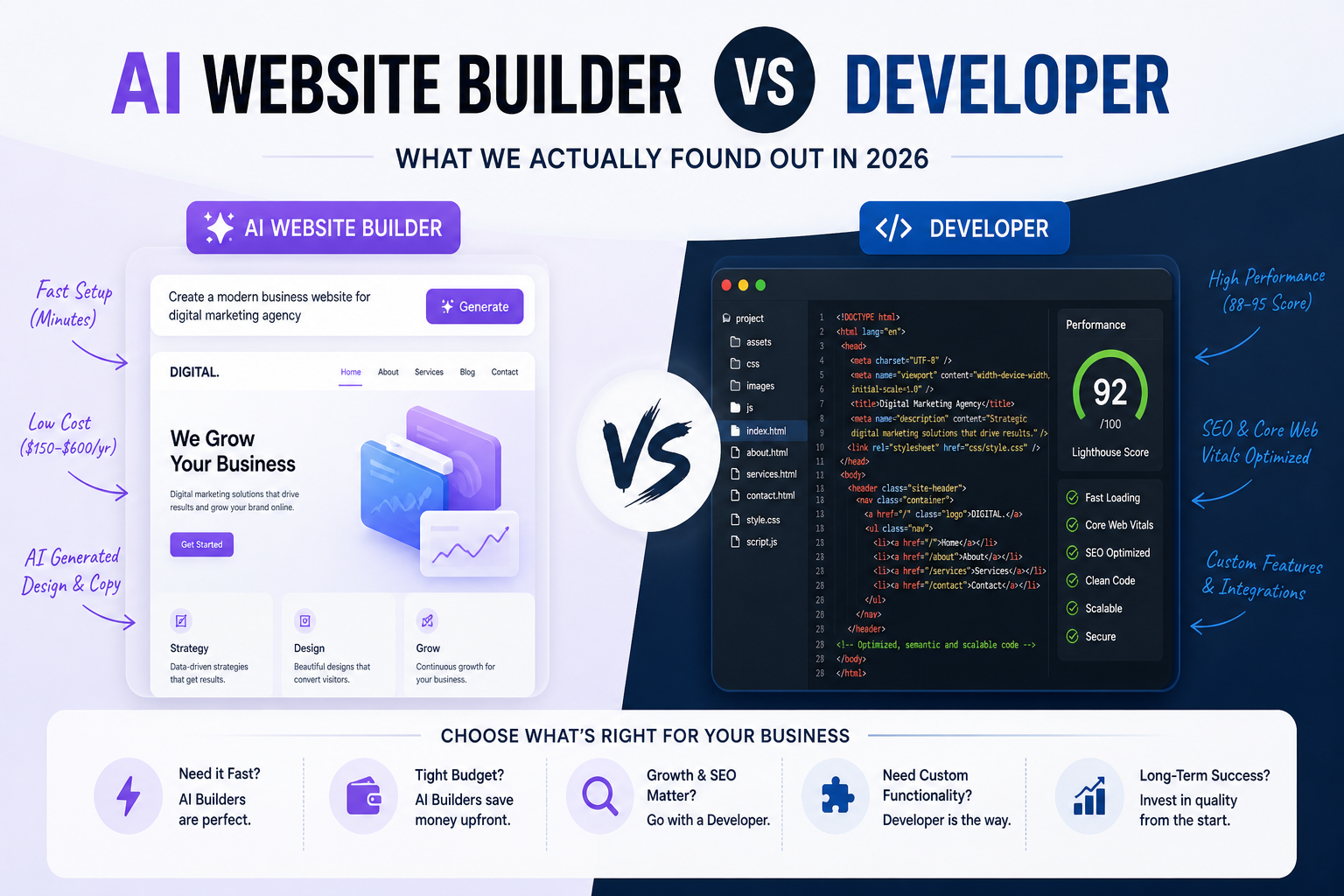
The AI website builder vs developer debate has become one of the most searched questions in web strategy in 2026. You have seen the demos: a complete website, generated in sixty seconds from a single text prompt. Copy, layout, imagery, colour palette, and basic SEO, all produced before you finish your coffee. If that is real, the obvious question follows immediately: why would anyone pay a developer thousands of pounds or dollars to do something a tool can do in under a minute?
It is a fair question, and in 2026 it deserves a genuinely honest answer: not a defensive one from the development industry, and not an overhyped one from the AI builder space. The technology has improved significantly. But “improved significantly” and “better than a developer” are not the same thing, and the gap between them is where most businesses make expensive mistakes.
This AI website builder vs developer breakdown covers what the tools can actually do well in 2026, where they fall short, and what the data says about performance, SEO, and long-term business outcomes.
Quick Answer: AI Website Builder vs Developer
AI website builders are the right choice if: You need an online presence quickly, your site is primarily informational, your budget is under $2,000, and you do not depend on organic search or custom functionality for revenue.
A professional developer is the right choice if: Your website is a primary growth channel, you need custom integrations, your organic search performance matters, or you are building something that needs to scale with your business over time.
The more important answer: in 2026, the strongest websites are increasingly built by developers who use AI tools to work faster, not by AI tools operating without developer judgment.
What AI Website Builders Can Actually Do in 2026
The honest starting point is that AI builders are meaningfully better than they were two or three years ago. The early wave of tools produced generic layouts, boilerplate copy, and sites that looked identical regardless of the brief. That era is largely over.
By 2026, the AI website builder vs developer gap has narrowed to the point where most small businesses simply cannot justify the difference in cost or time for a basic online presence. Tools like Wix ADI, Framer, Squarespace AI, and Webflow AI can now generate multi-page sites with coherent layouts, contextually relevant copy, and mobile-responsive design from a text prompt.
You can generate a basic, functional layout in under 30 minutes, representing a 60% reduction in initial creation time compared to manual layout building. For a business that needs a landing page, a portfolio, or a local service site up and running this week, that speed is real and meaningful.
The cost picture is also genuinely favourable on the surface. Custom agency sites average $2,000 to $10,000, while AI builders cost roughly $150 to $600 annually. If you are a freelancer, a local business, or an early-stage startup validating an idea, those numbers make a strong case.
Where the AI Website Builder vs Developer Gap Actually Shows Up
Here is where the comparison gets uncomfortable for AI builder advocates.
Websites built on drag-and-drop AI builders average a Lighthouse performance score of 45 to 60, compared to 88 to 95 for custom-built websites. That is not a marginal difference. Lighthouse scores in the 45 to 60 range produce real-world consequences: slower load times, higher bounce rates, and direct penalties from Google’s page experience signals.
Most AI builders load heavy JavaScript frameworks and unoptimised assets by default. LCP scores above 4 seconds are common, which represents a significant Google ranking penalty in 2026. A Largest Contentful Paint above 4 seconds puts a site firmly in the “poor” category according to Google’s Core Web Vitals thresholds, and that classification affects how the site is ranked in search results.
This matters more than most AI builder marketing suggests. A beautiful site that loads slowly is not a better website. It is a liability dressed up as a launch.
The SEO Gap Is Wider Than It Looks
Performance scores are one problem. The SEO architecture problem is a different one, and it compounds over time.
AI builders produce sites that look SEO-ready. They generate meta descriptions, title tags, and sitemaps automatically. But the structural decisions that determine whether a site actually ranks (URL architecture, internal linking logic, schema markup implementation, canonical tag handling, and crawl budget management) require deliberate judgment that automated tools do not apply consistently.
Custom-built sites handle semantic HTML correctly from day one because a developer makes the choice. Wix, Squarespace, and most WordPress themes generate exactly that “div soup” automatically because their builders think layout-first, semantics-second.
The schema markup point is particularly important. A January 2026 analysis citing a Semrush study covering five million URLs found that structured data is a consistent driver of citations in Google AI Mode and ChatGPT Search. AI builders generate schema inconsistently and often incorrectly. A developer implementing it deliberately, following Google’s structured data guidelines, produces results that AI-generated code frequently does not.
For stores, service businesses, and content sites where organic search is the primary acquisition channel, this gap compounds year over year. A site that ranks poorly in year one continues to underperform in year two, and the cost of migrating and rebuilding to fix the underlying architecture is almost always greater than the cost of building it correctly the first time.
If you are building on WooCommerce and organic search is central to your growth strategy, the Lucanix breakdown of WooCommerce versus Shopify covers this architecture question in more depth, including how platform choice affects your SEO ceiling.
What AI Does Well in a Developer’s Hands
The most useful framing when evaluating an AI website builder vs developer is not which one wins outright. It is whether you are comparing AI as a standalone tool against AI as something a skilled developer uses to work faster.
More than 81% of developers report increased productivity when using AI tools in their workflows. Tools like GitHub Copilot, Cursor AI, and v0 by Vercel allow developers to generate component boilerplate, prototype layouts, and automate repetitive code tasks in a fraction of the time those tasks previously required.
AI can cut design time by 20 to 40% and content creation time by 30 to 50%, with the biggest savings in repetitive tasks like basic copywriting, initial layout concepts, and technical SEO optimization.
The practical outcome is that a skilled developer using AI tools in 2026 can deliver a custom-built site faster and at lower cost than a developer working without them, while still applying the architectural judgment that produces good performance and SEO outcomes. This hybrid model, AI-assisted professional development, delivers speed benefits similar to AI website builders but without any of the technical limitations.
This is the version of the AI-versus-developer question that most comparison articles skip over. The correct comparison is not “AI builder versus developer working the way developers worked in 2019.” It is “AI builder versus developer augmented by AI tools.” The latter still wins on every technical metric that affects long-term business outcomes.
What Most Businesses Get Wrong
The mistake is treating website cost as the primary variable in the decision.
An AI builder at $300 per year looks dramatically cheaper than a developer at $5,000. But that comparison only holds if the website is delivering equivalent business outcomes. If the AI-built site loads slowly, ranks poorly, and cannot be customised to your actual conversion flow, the cost of the revenue it is not generating dwarfs the money saved on the build.
Engineers on Hacker News have been calling out the “Productivity Paradox”: yes, an AI can write code faster than a human, but it often produces a “black box”: code that is messy, unoptimized, and nearly impossible for a human to debug later. When your AI-generated site inevitably glitches, you are left with a “Frankenstein” backend that even experienced developers struggle to fix.
The question worth asking before choosing a tool is not “how much does this cost to build?” It is: “What is this website supposed to do for my business in twelve months, and does this approach actually support that?”
For businesses that have invested in content and want their site to be found through organic search, it is also worth understanding what actually makes a website perform commercially, not just aesthetically. The Lucanix article on why your business website needs more than a pretty design addresses exactly this distinction.
Use Case Scenarios
Best for an AI builder
You are validating a business idea, launching a personal portfolio, or setting up a local service business that will primarily get customers through referrals and social media. Your site needs to look credible and load reasonably fast, but it is not your primary growth engine. An AI builder gives you a professional result quickly at a price that matches the risk level of the project.
Best for a professional developer
You are building a WooCommerce store, a SaaS product site, a content-driven business, or any site where organic search, custom integrations, or complex functionality are central to revenue. The performance gap, the SEO architecture gap, and the customisation ceiling of AI builders will all become problems at scale, and they are significantly cheaper to solve before launch than after.
Best for the hybrid approach
You are working with a developer or agency that actively uses AI tools in their workflow. You get the speed benefits of AI-assisted development alongside the architectural judgment of someone who understands performance, SEO structure, and long-term maintainability. This is where most of the professional market is moving in 2026, and it is the combination that produces the strongest outcomes.
Final Verdict
The AI website builder vs developer question does not have a single right answer. AI builders are a genuinely useful tool for a specific set of use cases, and they have earned their place in the landscape.
For businesses that need an online presence quickly and are not depending on that site to drive organic traffic, generate leads through search, or support complex functionality, an AI builder is a reasonable choice in 2026. The output is better than it used to be, and the cost is hard to argue with.
For businesses where the website is a growth asset, the answer is still a developer, ideally one who uses AI tools to work faster, deliver more, and charge less than a developer working without them. The performance data, the SEO architecture gap, and the long-term ownership question all point in the same direction.
The right question is not “can AI build a website?” It can. The right question is “can AI build the website my business actually needs?” For most serious businesses in 2026, the honest answer is not yet.
Frequently Asked Questions
In the AI website builder vs developer debate, which is better for SEO? AI website builders can appear in search results, but they face structural disadvantages compared to custom-built sites. The combination of heavier JavaScript loading, inconsistent schema markup, and limited URL architecture control means AI-built sites tend to underperform custom-built sites on organic search over time. For low-competition local searches, an AI builder may be sufficient. For competitive niches where organic search is a primary growth channel, the performance and architecture gap becomes a meaningful disadvantage.
How much does a professional website cost compared to an AI builder in 2026? AI builders typically cost $150 to $600 per year. Professional custom development starts around $2,000 for basic sites and runs $5,000 to $10,000 or more for complex builds with custom functionality. The cost comparison changes significantly when you factor in the business outcomes each produces, particularly for sites where organic search, conversion optimisation, or custom integrations are involved.
Are AI builders getting good enough to replace developers entirely? Not for sites where performance, SEO architecture, and custom functionality matter. The trajectory of improvement is real, but the gap in Lighthouse scores (45 to 60 for AI builders versus 88 to 95 for custom builds) reflects a structural problem, not a feature gap. Developers using AI tools are also improving in speed and cost, which means the competitive advantage of AI builders is narrowing faster than the quality gap is closing.
What is AI-assisted development and why does it matter? AI-assisted development is what happens when a professional developer uses tools like GitHub Copilot, Cursor, or v0 by Vercel to generate code faster, prototype components in minutes, and automate repetitive tasks, while still applying expert judgment to architecture, SEO structure, performance, and custom logic. It delivers the speed benefits of AI builders without the technical ceilings, and it is increasingly how professional development agencies operate in 2026.
Should I use an AI builder to launch quickly and then migrate to a custom build later? This is a common strategy, and it can work if the migration is planned correctly. The risk is that SEO equity built on an AI platform is difficult to transfer cleanly. URL structures change, schema markup needs to be rebuilt, and 301 redirect mapping requires careful execution. If you start on an AI builder knowing you will migrate, treat it as a temporary validation tool rather than a long-term foundation, and plan the migration before you need it rather than after.
What should I look for when hiring a developer in 2026? Look for someone who uses AI tools in their workflow but applies independent judgment to architecture and performance decisions. A developer who cannot explain how they approach Core Web Vitals, structured data, or database optimisation is not equipped to build a site that performs long term. For a detailed framework on evaluating and hiring the right person, the Lucanix guide on how to choose a WooCommerce developer covers the interview questions and evaluation criteria that apply beyond WooCommerce specifically.
If you are navigating the AI website builder vs developer decision for a real project and want a perspective grounded in data rather than marketing, Lucanix works with businesses at the intersection of web strategy and organic growth.